The handoff used to settle who did what. It doesn't anymore.
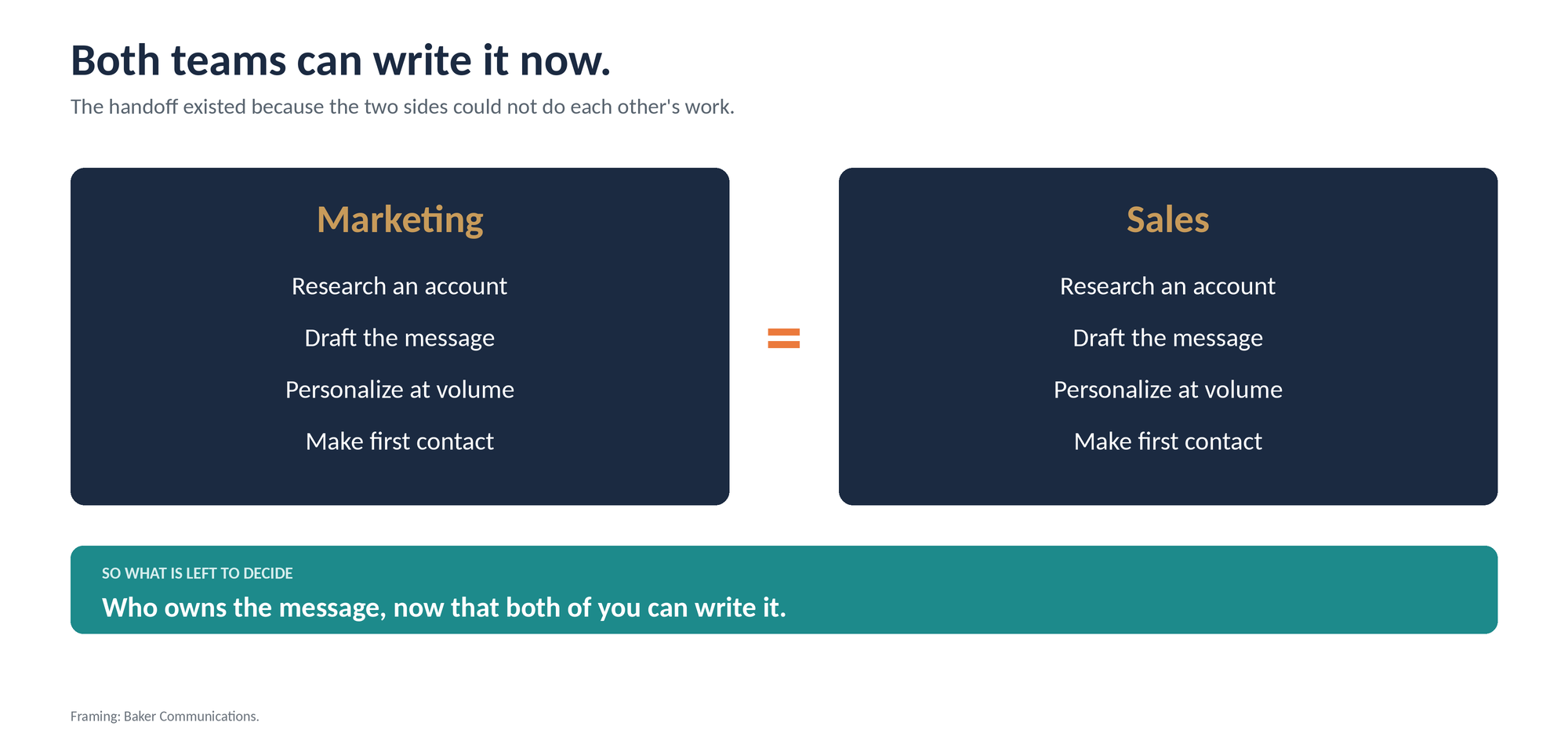
There used to be a pretty clear division between marketing and sales. Marketing built the campaigns, wrote the messaging, and created the content. Sales took that material, worked the account, personalized the conversation, and moved the opportunity forward. It wasn't perfect, but everyone generally understood where one team's job ended and the other began.
AI has made that line a lot blurrier, because both teams can now do work that used to belong pretty clearly to the other. A seller can create polished messaging, build account-specific content, and draft outreach that once would have needed marketing support. Marketing can take a broad campaign and personalize it down to an individual account or buyer in ways that used to be much harder to do at scale.
That's where the old handoff starts to get less useful. If both teams can create the message, personalize the message, and reach the same account, who actually owns what? And more to the point, has the way we've defined those roles kept up with the way the work is actually getting done?
There's an interesting disconnect in the data. In Forrester's Priorities Survey, 82% of C-level B2B professionals said their product, sales, and marketing teams are aligned1. But in the same body of research, leaders describe real costs from a lack of functional alignment: poorer customer experiences, transformation efforts that stall, and growth left on the table.
So executives believe their teams are aligned, and they're also naming the consequences of misalignment in the same breath. That gap makes us wonder whether the issue is less about whether sales and marketing are aligned, and more about whether the old definition of alignment still fits how the work actually gets done now.
For a long time, the handoff between marketing and sales did more than move a lead from one team to another. It helped settle who was responsible for what. That worked when the jobs on either side were more distinct. As those lines have blurred, the handoff itself doesn't answer nearly as much as it used to.
And AI doesn't appear to be reducing the need for coordination between people. ActivTrak's analysis of 443 million hours across 1,111 companies found that after AI adoption, collaboration time rose 34%, messaging rose 145%, and email rose 104%2. That tracks. When more than one team can do the work, someone still has to decide who should do it, when, and what the buyer should hear. Without a clear answer, those decisions don't disappear. They just start happening informally, one message at a time.
| The Handoff Used To Settle | Now It Takes A Decision |
|---|---|
| Marketing creates, sales personalizes | Both teams can do both |
| Marketing owns the message | Ownership has to be defined |
| First contact comes from one side or the other | Both may reach the same account |
| A lead marks where one job ends and the next begins | Both teams may stay involved throughout |
| Alignment means the handoff works | Alignment means the buyer hears one clear message |
The tricky part is that the work can change long before anyone updates the roles around it. Workday found that in 89% of organizations, fewer than half of roles have been updated to reflect what AI can now do3. So people take on new kinds of work, use new tools, and make decisions that may not have belonged to their role a year or two ago, while the structure around them stays mostly the same.
That can work for a while. Sales and marketing figure it out as they go. They message each other, adjust the outreach, and decide who's doing what, account by account. But that's also where the cracks start to show. Two teams reach out to the same buyer. The messaging doesn't quite match. One side thinks the other owns the next step. None of it necessarily shows up as a problem in a dashboard. The buyer just experiences a company that doesn't quite seem to be talking to itself.
That matters because the upside of getting it right is real. Organizations reporting very high strategic and operational alignment reported meaningfully higher revenue than organizations with no alignment at all1.
Pick one account that closed last quarter and trace every outbound touch it received from both sales and marketing. Put them in order, then look at each one and ask: who decided what we were saying here?
Not who sent it. Who decided the message. Look for where ownership was clear, where it got fuzzy, and where sales and marketing may have been saying slightly different things to the same account.
That simple exercise tells you a lot, because it shows you the experience from the buyer's side, not just the process from yours.
For a long time, the handoff between sales and marketing created clarity. It helped define who owned what, when one team's work ended, and when the other stepped in.
AI has changed enough of the work that the handoff can't do all of that on its own anymore. Both teams can now research, write, personalize, and engage the same account. So alignment has to include something more deliberate: clear decisions about ownership, messaging, and how the two teams work together across the account.
The handoff used to create the clarity. Now the teams have to create that clarity themselves.
Up Next: The Skill Nobody Is Actually Hiring For
Ask what AI skills a team needs and the answers usually come back technical. Prompting. Tool fluency. Automation. Data.
And yes, employers want those skills. But the skills they continue to call essential are things like analytical thinking, resilience, judgment, and the ability to influence people. That creates an interesting gap between the skills growing fastest and the skills organizations still depend on most. The next post looks at what that means for hiring, and why a team can become much more fluent in AI without necessarily becoming better at making decisions.
Sources
Numbered citations throughout this article draw on the sources above.
