← AI & the Future of Selling: see all 11 pieces in this topic
Jamie Dimon says AI will bring huge efficiency to certain parts of JPMorgan. Their annual report already told us which parts.
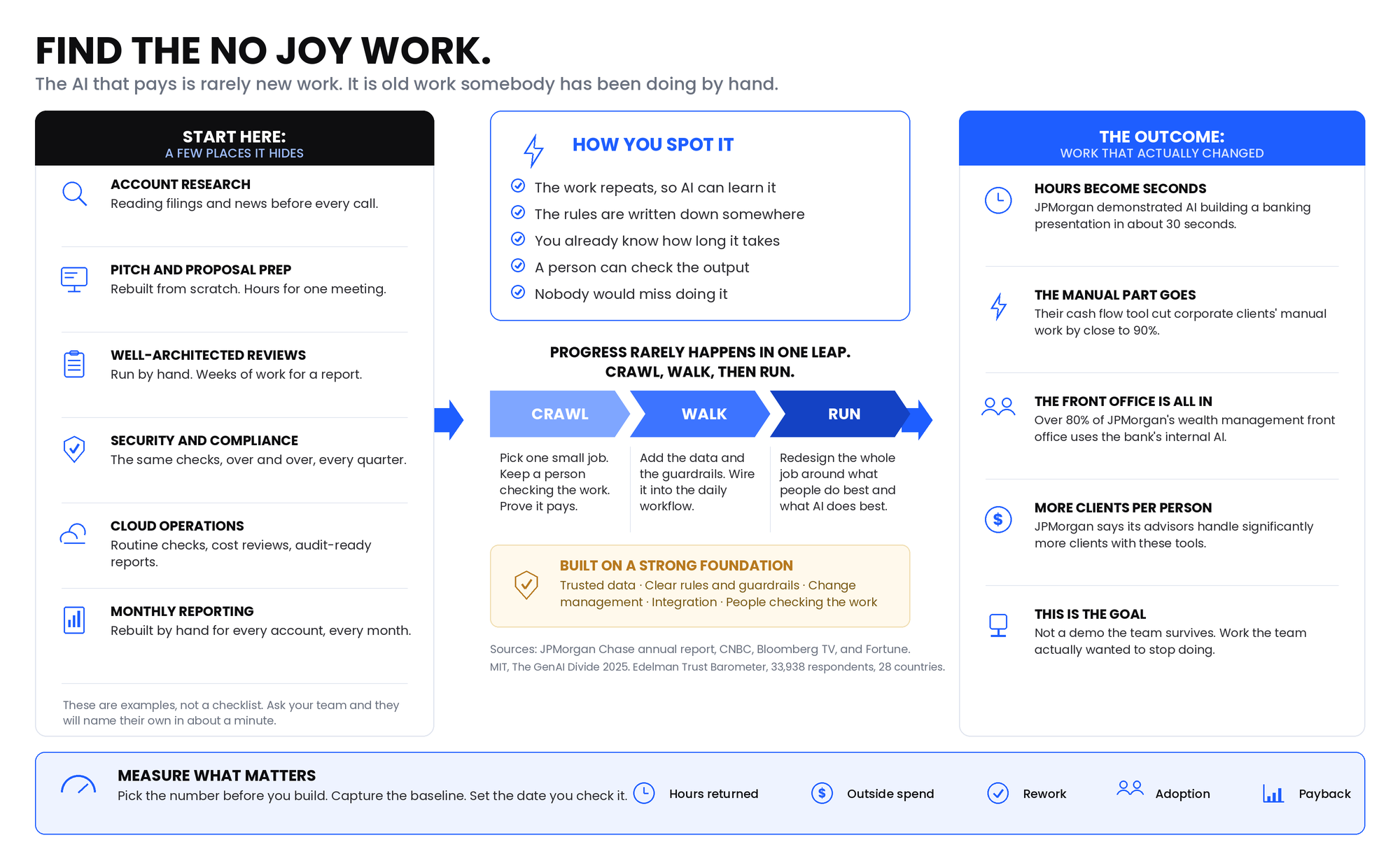
The AI that pays is rarely new work. It is old work somebody has been doing by hand.
Jamie Dimon said this morning that JPMorgan fully expects AI will bring huge efficiency to certain parts of the company. Certain parts. Not all of it. He also said the bank is running nearly a thousand AI use cases1. So which parts? That is the whole question, and most companies are figuring this out.
Turns out JPMorgan already answered it, in their own annual report. Over 80% of their wealth management front office uses the bank's internal AI. And here is how the report describes what they do with it. Every day, they look for opportunities to eliminate what they call "no joy" work and repetitive tasks2.
No joy work. That is the whole strategy, sitting in a filing.
Look at where it shows up. JPMorgan's chief analytics officer demonstrated the AI building an investment banking presentation in about 30 seconds, work that used to take a junior banker hours. Their advisors use it to read earnings transcripts and compare financial documents, and the bank says they now handle significantly more clients. A cash flow tool the bank built cut its corporate clients' manual work by close to 90%.
None of that is new work. All of it is old work somebody had been doing by hand.
And it shows up everywhere. In wealth management. In the pitch deck. In the research a seller does before a call. The pattern isn't a department. It's the antiquated process, wherever it happens to live.
| Chasing the shiny thing | Hunting the no joy work |
|---|---|
| New work nobody has done before | Old work somebody does by hand |
| No baseline, so no proof | You already know how long it takes |
| The team gets a memo | The team names the work themselves |
| Success is a screenshot | Success is a job nobody has to do anymore |
Walk over to the team doing the work and ask one question. What is the thing you do every week that you wish a machine would do for you? Write down the top five answers. Score each one against the pattern.
Then start with one small job and keep a person checking the work. Prove it pays. Add the data and the guardrails, so the safe way is also the fast way. Then let the person who built it show the rest of the team. Edelman, who has tracked global trust for 26 years across 28 countries, found people trust their own coworkers more than they trust any institution3.
Last week I shared MIT's number: 95% of enterprise AI pilots produce no measurable return4. The 5% that worked didn't find a better model. They found the no joy work.
Finding it is the first move. The second one is what you owe the team once the work goes away, and that is a bigger conversation than most leaders are having.
Apply It
The infographic at the top of this post is the whole argument on one page. Print it, take it into your next planning conversation, and use the left column to start the discussion.
Then go ask the question that matters. What is the no joy work your team wants to get rid of? They will name it in about a minute, and that answer is where your first AI project should start.
Download the InfographicSources
Numbered citations throughout this article draw on the sources above.
